By Lydio Mangao, Jr.
Chile’s Global Ecological Significance
Did you know that there are 110 identified ecosystems worldwide, and 88 out of these are found in Chile? This incredible diversity stems from Chile’s unique geography, stretching across Antarctica, South America, and the Pacific. Within its borders lies eight biomes or 15 ecological zones, ranging from the Atacama Desert―the driest place on Earth―to the Mediterranean climate of Santiago, glacier-fed rivers, the high Andes Mountains, and the rich marine life supported by the Humboldt Current.
Faith and Creation
As a person of faith, especially as a Catholic, this amazing biodiversity is more than just a natural wonder; it is a sign of God’s creative work. In these landscapes and ecosystems, we are reminded that God has entrusted us with their care. By appreciating what Chile has, we come to recognize not only its beauty, but also the responsibility we have as stewards of Creation.
Creed, Scripture, and Stewardship
Chile’s 88 ecosystems account for about 80% of the world’s ecosystems. In the Catholic faith, we believe in the Creator of Heaven and Earth, as we say in the Creed at every Mass. In Genesis, our sacred scripture tells us that everything God created was good. I find deep beauty in this faith.
As God’s creatures, made in His image and likeness, we have been entrusted with special gifts and abilities. With these, we are called to care for creation. The 88 ecosystems in Chile―with their plants and animals―are concrete examples of God’s creation.
Community and Legal Protection
In Chile, people work together to protect their country’s biodiversity through laws and community action. There are laws in place, and many groups, like volunteers, local communities, indigenous peoples, and government departments, help care for these ecosystems. Citizens can report violations using government platforms, and the media encourages people to speak up when protected areas are threatened.
Political Context and Leadership
Chile’s new president, Jose Antonio Kast, is a devout Catholic, husband, and father of nine. His right-wing administration, uses the slogan “working for you.” As part of an internal review process, the government withdrew 43 environmental decrees that had been signed under the former President Gabriel Boric. These decrees were intended to protect plants and animals in Chile’s 88 ecosystems.
According to Chilevisión Noticias, José Ignacio Vial, Undersecretary of the Environment, explained that the controversial withdrawal was carried out “within the framework of the internal audit plan of the Kast government,” which calls for a thorough and exhaustive review of all pending decrees and regulations.
Recently, one of the 43 decrees was reinstated, offering protection to the Darwin frog, a species found only in Chile. This leaves 42 decrees still awaiting review and resolution.
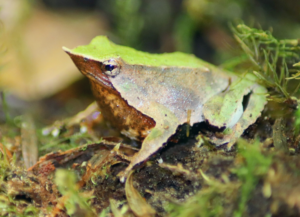
Darwin Frog (Source:https://en.wikipedia.org/)
Risks and Threats to Biodiversity
With 42 decrees still pending reinstatement, many plants and animals are left without legal protection. Because of this, ecologists, animal rights activists, and environmentalists have expressed growing concern about the risks to biodiversity. These developments have left many feeling sad, concerned, anxious, angry, and helpless.
Views of the Experts
As reported in Ladera Sur News Agency, Marcelo Mena, an academic at the School of Environmental Engineering at the Catholic University and former Minister of the Environment, explained that “each one of these decrees goes through a process of citizen consultation, consolidation of those consultations, preliminary drafts, final projects, among others. These processes often took many years. They involved pollution control plans, environmental standards, cost‑benefit analyses, and highly technical procedures where the costs of implementation are weighed against the benefits to health and the environment, all expressed in economic terms. These are reviewed by the Council of Ministers. It is not something arbitrary; it happens within a legal framework with established deadlines.”
Sara Larraín, an ecologist and the director of Chilean Sustainable Program, said: “There is a global regression of everything that has been achieved—not only in the last four years, as in the case of SBAP, Chilean government institution created to manage biodiversity and oversee protected areas, ensuring conservation of ecosystems, flora, and fauna, and the climate change policy―but of everything that has been advanced in the last decade. It is extremely serious and clearly a signal of wanting to stop or dismantle environmental regulations and the rules that protect the health of the population.”
National Gathering and Response
During a 2026 national gathering of ecologists in Chile, some groups criticized the decision to withdraw the decrees for review, describing it as an environmental regression. Hundreds of environmental and socio-civic groups, NGOs, and governmental organizations attended. At the meeting, a collective space was formed to coordinate an ecological, legal, and nonviolent response. As a result, a concrete strategic action was outlined to address the factors that weaken protection and threaten ecosystems, flora, fauna, and biodiversity.
March for Water and Biodiversity
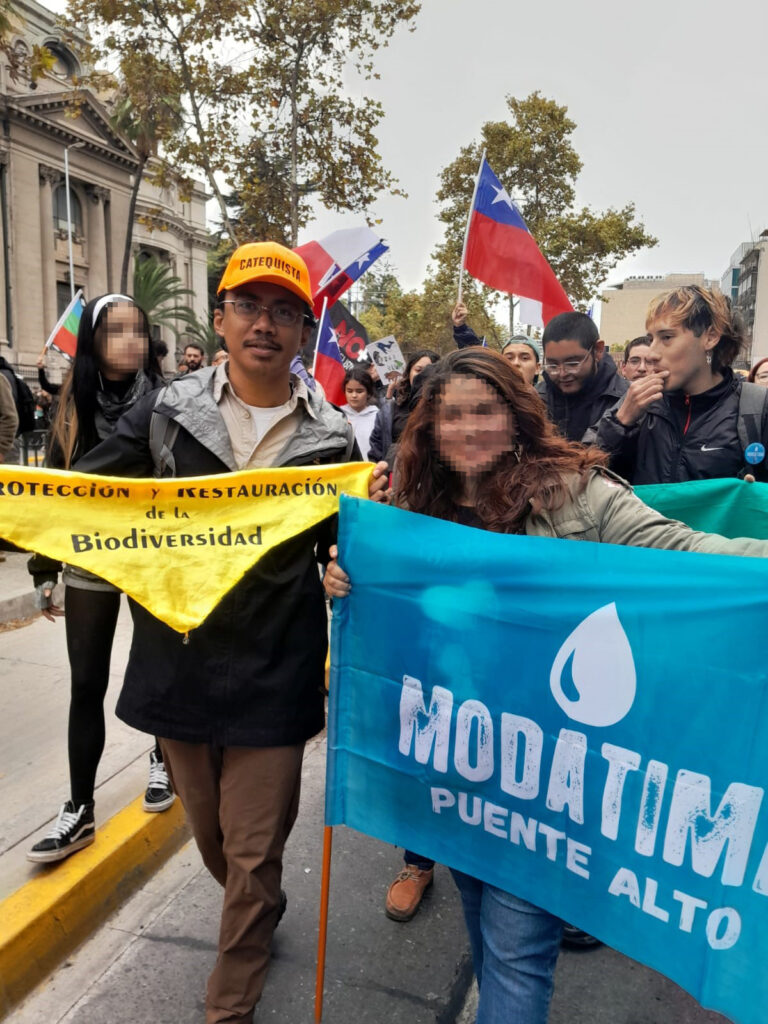
On World Water Day, the day after the national gathering, thousands of people from across Chile marched for water. Noticias Ambientales reported that demonstrators demanded the urgent reinstatement of the 42 environmental decrees into Chilean law. They demanded that there should be no elimination of environmental standards, no weakening decision against protected areas, and no reduction in the technical requirements upheld by the state environmental agencies.
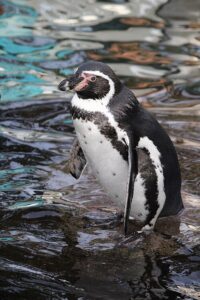
The report also highlighted the threat posed by the Dominga Mining Company. The Dominga project plans to build iron and copper mines near the Humboldt Penguin National Reserve, which is home to 80% of the world’s Humboldt penguins, as well as whales, coastal otters, and other important marine species. The company’s plan to build a seaport puts this marine life and the ecosystem at serious risk.
Faith in Action
I joined the march as a Catholic and Columban missionary, carrying a banner in Spanish that read: “Protection and Restoration of the Biodiversity.” I also wore a neon-orange cap that says “Catechist.” While I am aware that this March for Water can be very polarizing, divisive, and politicized, my solidarity with the Chilean people comes from my profession of faith—faith in action, a faith that belongs to a church that is present at the peripheries, and at times, at the center of the main street. As I reflect on this experience, I am reminded that Santiago lies within the dry Mediterranean zone, and that the Chilean people understand drought and wildfire in ways far deeper than I do.
Rivers and Local Threats
As I walk through the streets, I think about the Mapocho River, which runs through the heart of Santiago. There is a threat to this river: a mining company is seeking to expand its operations downward, which could harm the underground water near the Yerba Loca National Reserve. Located within Santiago, this reserve is a place I have passed by four times. I have come to appreciate how it helps the ecological balance for the people living in the Santiago valleys.
Water as Symbol and Gift
I pause in reverence for the Chilean people who have endured drought and wildfires. While I may not fully understand their pain, I know that thirst, the joy of rivers, and the water used in baptism remind me that water is both a spiritual symbol and a basic need. Every drop is a gift from God. There is no true life without water, and it is essential for peace and justice every day.
Pastoral Reflection.
Presence and Collaboration
At the national assembly of ecologists and during the March for Water, I witnessed how deeply Chilean communities care about nature. At the same time, I noticed that the Catholic Church is hardly present in these spaces; it may even be a minority voice in responding to the cry of the earth. This gap highlights the importance of Pope John Paul II’s call for ecological conversion. I pray that Laudato Si Movement Chile be around in these community circles.
Catholic Social Teaching and Ecological Conversion
This faithfulness to Catholic social teaching is something the Chilean Catholic Church can celebrate. Yet, her voice seems limited in daily life―in walking with others, and listening to the cry of the earth. Even so, I am hopeful, trusting in how the Holy Spirit can work through the Church, both in her human weaknesses and in her God-given strengths. I find myself wondering how Catholics should respond to government decisions that may harm creation while maintaining charity and unity?
Returning to Community and Eucharistic Joy
At the end of March, I returned to my community on the day of the March for the water, and we gave thanks to God. The church workers asked me to read the first reading at Sunday Mass in the Holy Spirit Chapel of the Columban Parish of St Matthias in Bajos de Mena, Santiago. As I prayed before the Eucharist that day, I felt the joy of sharing the Gospel.
Looking back, I thought I was the only church person on the streets, but I was wrong. That night, I saw a video on social media of a Franciscan in his habit, holding a sign on the sidewalk that same Sunday. I that moment, I felt united with all people, despite the differences that may separate us.
In the end, we all need water. Access to safe, clean water is a basic human right. We must remember the deep, sacred value of water and biodiversity. I see hope for solidarity, for sacred spaces that work for the common good, and for places that listen to the cry of the earth.
Scripture, Magisterium, and Laudato Si
I see how the Sacred Magisterium and Sacred Scripture become tangible in Laudato Si, and I hope that Columbans can be trailblazers of the Laudato Si Movement in the Chilean parish. I dream and pray―fully awake― that both lay and ordained people, each with their God-given gifts and charisms, may recognize this missionary gap and, together, share the Gospel of Joy as a sacramental and, above all, incarnational response to the cry of the earth and to the cry of the poor.
Columban Mission Priorities
The Columbans have remained attentive to the needs of the times, and continuing to share the Joy of the Gospel, especially among the poor. From this attentiveness, two priorities have emerged―one of which is the protection and restoration of biodiversity. This reflects the Columban mission, grounded in Justice, Peace, and Integrity of Creation. It is a priority rooted in the Gospel and shaped by a missionary spirit, nourished by local experiences in Columban parishes and a global understanding of the places where we serve, always in solidarity with the poor.
Solidarity with the Poor and Ecological Vulnerability
The Columban commitment to serve alongside the poor is shaped by a global awareness of the poor’s vulnerability, especially as interconnected with the ecological crisis. Since 2015, the call of Laudato Si to hear the cry of the earth and the cry of the poor has been not just an invitation for Columban Missionaries, but also an affirmation of what we have long been striving to live as part of God’s mission, so that all people may have fullness of life.
Yet, in the grace of humility, we also recognize a paradox at the heart of our Catholic Faith. The Columban Missionaries are there, but not yet. The Chilean Catholic church is there but not yet. And so, all the more, we rely and ask for the grace of God, because we are there, but not yet. We are there, and still becoming.
Lydio Mangao, Jr. is a Filipino Columban student/seminarian currently on his First Mission Assignment in Chile.