By John Din, Columban Lay Missionary
I am a link.
A link to what? A link between what began decades ago and the imagined future of a recovered and restored forest.
In the early two thousands, San Columbano de Bantolinao was just a dream—a dream of a future where organic farming is enhanced and the forest restored on a bald mountain considered a watershed for Kabankalan city, Negros Occidental.
It all started with some members of Negros Nine. They are a group of nine people—six lay and three priests—who were falsely accused of murdering a mayor in 1983. From there, a dream of integral human development and society transformation was envisioned, where human rights and the protagonism of the poor are recognized.
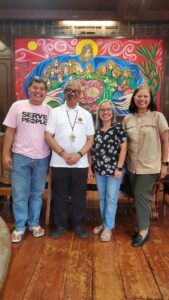
Living on an island heavily dependent on sugar cane, the protagonist realized that the call for human transformation is not situated in a vacuum; it calls for greater understanding— from integral human development to what Pope Francis called integral ecology in Laudato Si’. This journey towards an expanded understanding of integral human development led to the birth of Santuario de San Columbano, a forest restoration project of the Negros Nine.
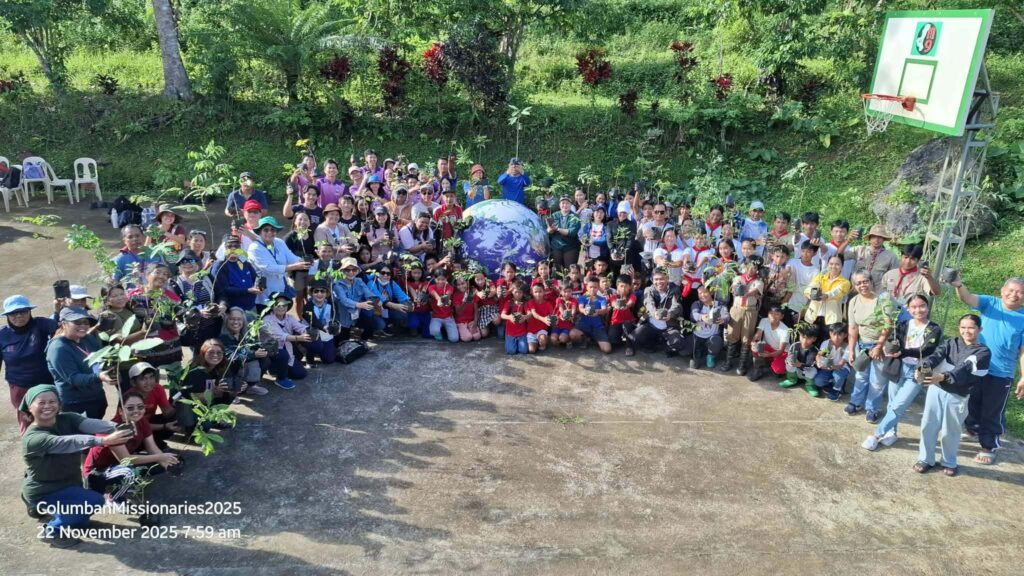
Through the years, hundreds of people have been involved in trying to reforest and stonewall an area of around sixty hectares of land. Mostly planted with native trees, the project has survived a series of typhoons that damaged the planted trees, the threat of charcoal making from people trying to survive during the lean months while waiting for the sugar cane harvest, the spell of drought and the La Niña phenomenon.
Yet, despite it all—and with very little government support—the forest restoration thrives. It has withstood the climatic challenges and human foolishness. Most sections of the forest are now able to sustain themselves with less human intervention. Different species of birds are now doing their job to bring more seeds to an ever-welcoming environment for growth. I presume that many species in the area are still to be known and discovered.
I moved to San Columbano de Bantolinao in June of 2025. The past few months have been dedicated to observation, understanding, and knowing the dynamics and patterns of this place. This has meant taking regular walks around the reforestation area while enhancing the organic farm.
This return to the land did not happen abruptly. Almost a decade of advocacy work in Manila had awakened in me a deep desire to go back to the land, to complement the advocacy work to care for people and creation.
I must recognize that there are many things that I do not yet know or fully understand about this place. Having spent years in the busy city of Manila, each day on the farm seems to be like any other day, but growth is quietly happening all around. It is often hard to see the subtle little growth that can only be recognized over time.
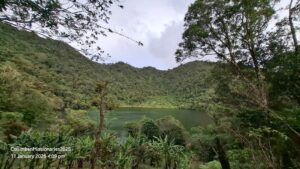
What inspires me is witnessing the great leap from the project’s beginnings to the present. After two decades, the fruits of community labor against all odds are astonishing, transforming a bald mountain into an Amazon-like forest. From above the canopy, one can easily mistake it as any tropical forest somewhere in the globe. What seemed impossible many years ago has been made possible by the countless people who have contributed to this enormous task.
For me, as a missionary living and working in this context, it is both a graced moment and a challenge to be part of the link between the past and the present, between the generations before us and those who will come after us. We are in a crucial context where life in its immense journey that brought out everything in all its forms is now threatened with extinction because of our way of living: a way of living that estranges us from the truth that we are part of the whole of creation.
This calls for a lifelong path of renewal – recovering that age-old wisdom and truths present in the worldviews of many indigenous peoples around the world and supported by science: that everything comes from the same source, is mutually interdependent, and shares a common future. The restoration of the forest, mindfulness of nature’s rhythms, and organic farming are pathways toward what Laudato Si’ calls “to thread on the long path to renewal”.